

The anterior cruciate ligament (ACL) is a strong band of tissue inside the knee that connects the thigh bone to the shin bone. It helps keep the knee stable during walking, running, jumping, and turning movements.
Overview
What is an ACL Tear?
The anterior cruciate ligament (ACL) is a strong band of tissue inside the knee that connects the thigh bone to the shin bone. It helps keep the knee stable during walking, running, jumping, and turning movements.
An ACL tear happens when this ligament stretches too much or tears partially or completely. It is one of the most common knee injuries, especially in people involved in sports and physical activities.
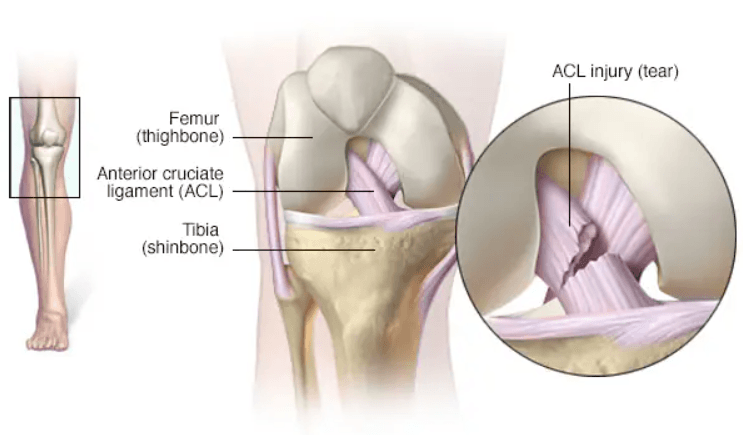
The ACL is important for keeping the knee stable. An ACL tear may cause the knee to feel unstable during movement or weight bearing. People with ACL injuries may also have a higher risk of knee osteoarthritis later in life.
Who is commonly affected?
ACL injuries are more common in:
- Athletes involved in football, basketball, badminton, skiing or cricket
- People who suddenly twist or pivot the knee
- Young adults and teenagers
- Women athletes (due to differences in body mechanics and muscle control)
- People with previous knee injuries
Why Does an ACL Tear Happen?
Most ACL injuries happen suddenly during movement rather than due to direct contact.
Common causes
- Sudden twisting of the knee
- Landing incorrectly after a jump
- Quickly changing direction while running
- Sudden stopping during sports
- Direct blow to the knee during sports or accidents
Many people report hearing or feeling a “pop” in the knee at the time of injury.
Risk factors
Certain factors may increase the risk:
- Playing high-impact sports
- Weak thigh or leg muscles
- Poor balance or training technique
- Previous ACL injury
- Inadequate warm-up before exercise
- Improper footwear or uneven playing surfaces
Signs and Symptoms
Symptoms usually appear immediately after the injury.
Common symptoms
- Severe knee pain
- Swelling within a few hours
- A popping sound or sensation during injury
- Feeling that the knee is unstable or “giving way”
- Difficulty walking or bearing weight
- Reduced knee movement
When should you see a doctor?
See a doctor if you have:
- Significant knee swelling
- Difficulty walking
- Repeated knee instability
- Persistent pain after injury
- Difficulty bending or straightening the knee
Early evaluation may help prevent further knee damage.
Diagnosis and Investigations
Doctors diagnose ACL injuries using medical history, physical examination and imaging tests.
Clinical evaluation
The doctor may:
- Ask how the injury happened
- Examine swelling and tenderness
- Check knee movement and stability
- Perform special knee tests to assess ligament injury
Imaging tests
X-ray: Helps rule out fractures or other bone injuries.
Magnetic resonance imaging (MRI): Commonly used to confirm ACL tears and check for damage to cartilage, meniscus (knee cushioning tissue), or other ligaments.
Ultrasound: Occasionally used to evaluate injuries in surrounding soft tissues.
Treatment Options
Treatment depends on activity level, severity of injury and lifestyle needs.
Immediate care
Doctors often recommend the RICE method:
- Rest – Rest to heal and avoid activities that worsen pain
- Ice – Apply ice packs every 2 hours for 20 minutes to reduce swelling
- Compression – Use an elastic bandage if advised
- Elevation – Keep the leg raised above heart level
- Medications
- Anti-inflammatory medicines such as ibuprofen or naproxen
Medicines should be taken only under medical advice.
Physiotherapy and rehabilitation
Physiotherapy is very important for recovery. Exercises help:
- Improve knee strength
- Reduce pain and swelling
- Restore movement
- Improve balance and stability
- Reduce the risk of future injury
Some people recover well with physiotherapy alone.
Lifestyle and self-care
- Avoid sudden twisting movements
- Maintain healthy body weight
- Use proper sports techniques
- Wear appropriate footwear
- Continue strengthening exercises regularly
When is surgery needed?
Surgery may be advised for:
- Complete ACL tears
- Athletes wishing to return to sports
- Repeated knee instability
- Combined injuries involving other ligaments or cartilage
ACL reconstruction surgery replaces the torn ligament using tissue taken from another part of the body or from a donor.
Recovery after surgery usually requires several months of physiotherapy and rehabilitation.
Myths and Facts
ACL tears only happen to athletes.
Anyone can develop an ACL injury after sudden twisting or trauma to the knee.
If pain improves, the ACL is healed.
Pain may reduce, but knee instability can continue if the ligament remains torn.
Surgery is always necessary.
Some people improve with physiotherapy and rehabilitation alone.
Rest alone is enough.
Proper rehabilitation and strengthening exercises are important for recovery and knee stability.
Frequently Asked Questions (FAQs)
Can I walk after an ACL tear?
Some people can still walk, but the knee may feel unstable or painful.
How long does recovery take?
Recovery may take weeks to months depending on severity and treatment. Recovery after surgery may take 6–12 months.
Can an ACL tear heal on its own?
A completely torn ACL usually does not heal fully on its own, but some people can manage symptoms with rehabilitation.
Can ACL injuries be prevented?
Strength training, proper warm-up, rest after intense physical activity and protective equipment may help reduce risk.
Speak to an orthopaedic specialist
Get an expert opinion and a personalised treatment plan at Sterling Hospitals.