

The meniscus is a soft, rubbery “cushion” inside the knee joint. Each knee has two menisci — one on the inner side and one on the outer side. They act like shock absorbers between the thigh bone and shin bone and help the knee move smoothly.
Overview of the condition
What is a meniscus tear?
The meniscus is a soft, rubbery “cushion” inside the knee joint. Each knee has two menisci — one on the inner side and one on the outer side. They act like shock absorbers between the thigh bone and shin bone and help the knee move smoothly.
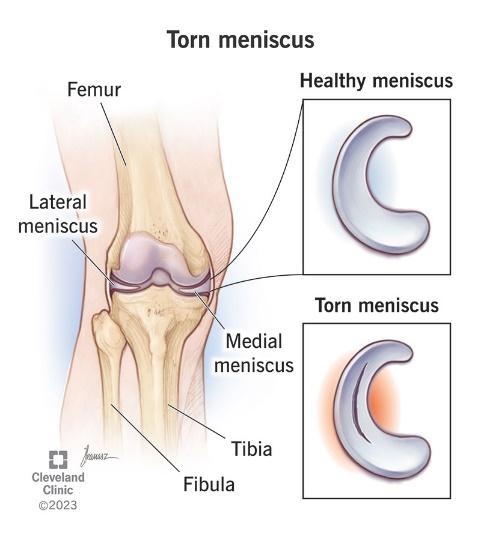
A meniscus tear happens when this cushion gets damaged or torn. This is one of the most common knee injuries.
Why is it important?
A torn meniscus can cause knee pain, swelling, difficulty walking, knee “locking” or getting stuck and trouble bending or straightening the knee.
If not treated properly, it may increase the risk of arthritis (wear and tear of the joint) later in life.
Who is commonly affected?
Meniscus tears can happen to:
- Athletes who play football, basketball, tennis, cricket or other sports involving twisting
- Older adults due to aging and joint wear
- People who squat, kneel, lift heavy objects or climb stairs frequently
- People who are overweight, as extra body weight puts pressure on the knees
Causes
Common causes
A meniscus tear usually occurs when the knee suddenly twists while the foot stays planted on the ground.
Examples include:
- Sudden turning while playing sports
- Falling awkwardly
- Deep squatting movement
- Lifting heavy weights
- Sudden stopping or pivoting movements
Age-related wear and tear
In older adults, the meniscus becomes weaker over time. Sometimes, even simple activities like standing up from a chair or stepping unevenly can cause a tear.
Risk factors
The risk is higher in people who:
- Play contact sports
- Are overweight
- Have knee arthritis
- Frequently kneel or squat
- Have weak thigh muscles
Signs and symptoms
Common symptoms
Symptoms may appear immediately or within 24 hours after injury.
Common symptoms include:
- Knee pain
- Swelling
- Stiffness
- Difficulty walking
- Pain while twisting the knee
- A licking or popping sensation
- Difficulty fully straightening the knee
Warning signs
Seek medical attention if:
- The knee gets ‘locked’ and cannot move properly
- You cannot bear weight on the leg
- Swelling becomes severe
- The knee repeatedly gives way
- Pain continues for several weeks
Diagnosis and investigations
Clinical evaluation
A doctor will ask about the injury, examine the knee, check swelling and movement and perform simple knee movement tests to check for pain or locking.
Imaging tests
X-ray: It does not show the meniscus itself, but it helps rule out fractures or arthritis.
Magnetic resonance imaging (MRI) scan: It is the best scan to detect a meniscus tear because it shows soft tissues clearly.
Arthroscopy: In this process, doctors use a tiny camera inserted into the knee through a small cut to directly look inside the joint. This is called arthroscopy. It can also be used to repair the tear during the same procedure.
Treatment options
A. Non-surgical management
A common approach is known as ‘RICE’:
R – Rest: Avoid activities that worsen pain, especially twisting or squatting.
I – Ice: Applying ice packs for 15–20 minutes helps reduce swelling.
C – Compression: Elastic knee supports or bandages may help reduce swelling.
E – Elevation: Keeping the leg raised helps decrease swelling.
B. Medications
Doctors may recommend:
- Pain-relief medicines such as paracetamol
- Anti-inflammatory medicines like ibuprofen to reduce pain and swelling
These should only be used as advised by a healthcare professional.
C. Physiotherapy (Exercise therapy)
Physiotherapy is very important and may include:
- Muscle strengthening exercises
- Balance training
- Stretching exercises
D. Lifestyle changes
Helpful lifestyle changes include weight management, wearing proper footwear during sports and regular strengthening exercises.
E. Surgery
Types of surgery include:
- Meniscus repair: The torn part is stitched back together.
- Partial meniscectomy: The damaged part is trimmed and removed.
- Meniscus replacement: Usually performed in patients over 50 years of age with knee arthritis.
Most surgeries today are performed using arthroscopy, which involves small cuts and a faster recovery.
Myths and facts
Every meniscus tear needs surgery.
Many tears improve with rest, physiotherapy and medicines.
Only athletes get meniscus tears.
Older adults and non-athletes can also develop tears from daily activities.
If I can walk, my knee is fine.
Some people can still walk despite having a tear.
Complete bed rest is best.
Guided movement and physiotherapy are usually important for recovery.
Frequently asked questions (FAQs)
Can a meniscus tear heal on its own?
Some small tears, especially those with a good blood supply, may heal with rest and physiotherapy.
How long does recovery take?
Recovery may take: A few weeks for mild tears Several months after surgery or severe injury
Can I continue walking?
Many people can walk, but painful activities should be avoided. If walking increases swelling or pain, consult a doctor.
Will I get arthritis later?
A severe or untreated tear may increase the risk of knee arthritis over time. Early treatment and exercise may help reduce this risk.
Speak to an orthopaedic specialist
Get an expert opinion and a personalised treatment plan at Sterling Hospitals.


